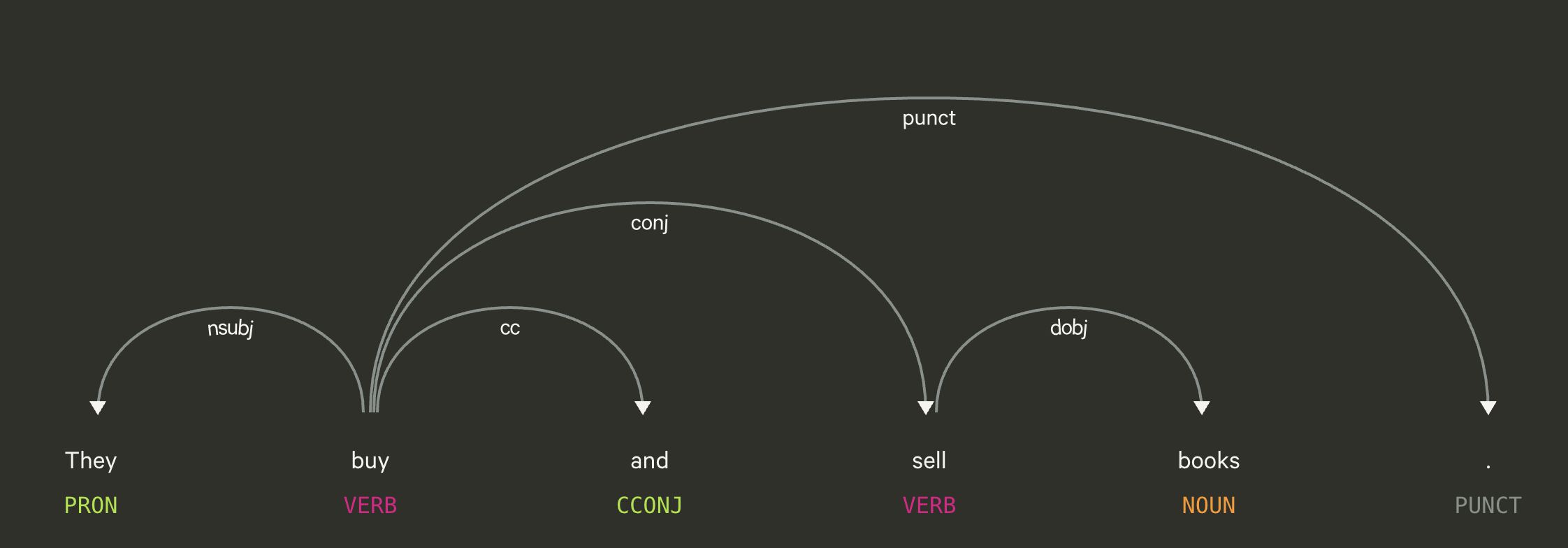
ID Form Lemma POS TAG MORPH HEAD DEP 1 They they PRON PRP Case=Nom|Number=Plur 2 nsubj2 buy buy VERB VBP Number=Plur|Person=3|Tense=Pres 0 root3 and and CCONJ CC _ 2 cc4 sell sell VERB VBP Number=Plur|Person=3|Tense=Pres 2 conj5 books book NOUN NNS Number=Plur 4 obj6 . . PUNCT . _ 2 punct
Dependency tree for “They buy and sell books.”
Applications in L2 research
How do learner across proficiency level use collocations?
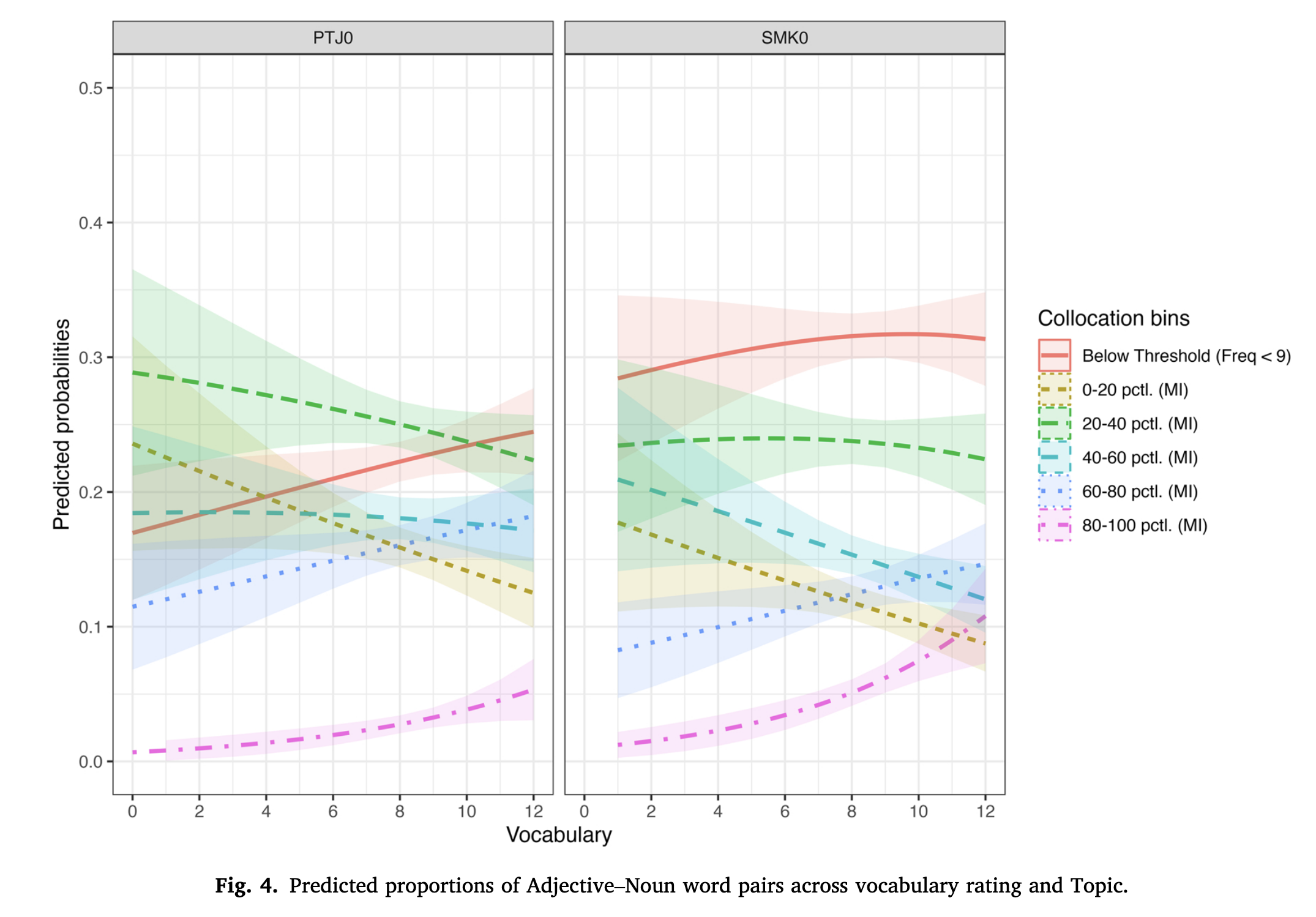
Adjective + Noun (JN)
Noun + Noun (NN)
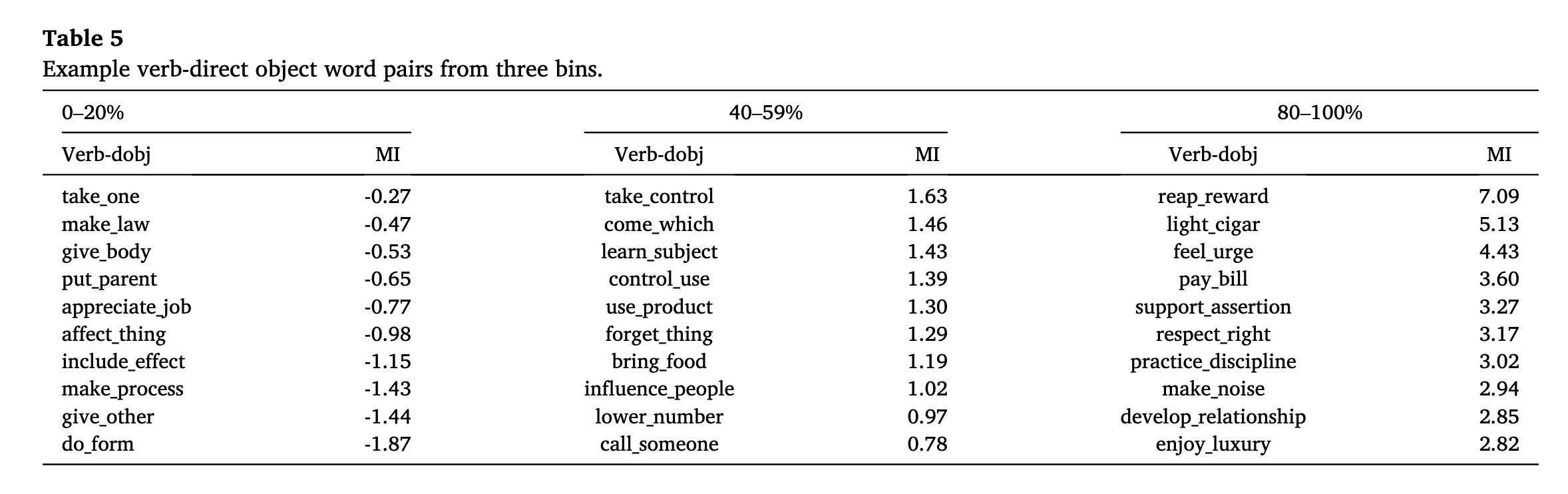
Verb + Noun (VN)
Eguchi, M., & Kyle, K. (2023). L2 collocation profiles and their relationship with vocabulary proficiency: A learner corpus approach. Journal of Second Language Writing, 60, 100975. https://doi.org/10.1016/j.jslw.2023.100975
Granger, S., & Bestgen, Y. (2014). The use of collocations by intermediate vs. advanced non-native writers: A bigram-based study. International Review of Applied Linguistics in Language Teaching, 52(3). https://doi.org/10.1515/iral-2014-0011
Collocation extraction
Word Sense Disambiguation
Word-sense disambiguation = decide which meaning a word carries in context. Same form, different sense.
She sat on the bank of the river. → riverbank
She deposited the cheque at the bank. → financial institution
The surface form is identical — only context resolves the sense. Harder than POS: the label set is per word, not a fixed grammar.
Stance
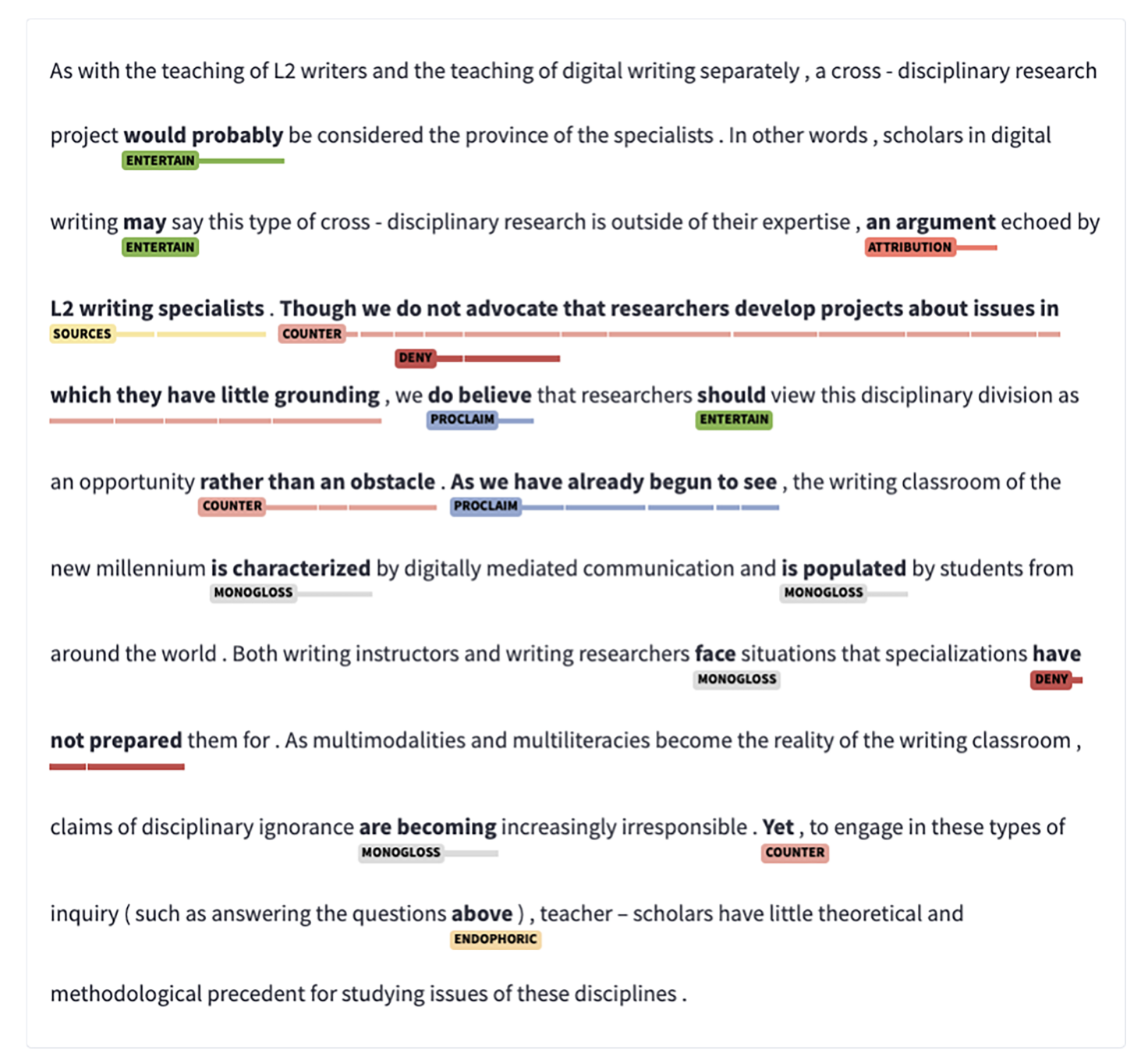
Stance annotation = label how a writer positions themselves toward a proposition .
Unit of analysis is a span - textual segments with specified beginning and end.
Engagement Span Annotation (Eguchi & Kyle, 2023)
Discourse Moves
Move analysis = label what a stretch of text does rhetorically. Classic CARS model for research-article introductions (Swales):
Move
Function
Move 1
Establishing a research territory
Move 2
Establishing a niche
Move 3
Presenting the present work
Kim & Lu (2024) had GPT annotate these moves — near-perfect when fine-tuned, though steps stayed hard. Unit: sentence/clause → one label.
Summary: NLP task by unit and output
Task
Unit of analysis
Label example
Note
POS tagging
Each token
NOUN, VERB, ADJ
Token-level sequence labelling — one label per token
Dependency parsing
A pair of tokens
nsubj, obj
One relation per head–dependent pair
Stance annotation
A stretch of text
hedge, booster, ATTRIBUTE
Span categorization — the span boundaries are part of the annotation
Rhetorical move analysis
A sentence
Background, Gap, Method
Unit categorization — one label per unit
Sentence difficulty (CEFR)
A sentence
B2, C1, C2
Unit categorization — one label per unit
Register classification
A whole text
academic, news, fiction
Unit categorization — one label per unit
The scope of the current course
We will focus mostly on sentence categorization and text categorization:
The evaluation code is easy to build.
the canonical {id, text, label} schema you met in S3 is sufficient.
data = {"id": 1,"text": "","CoderA": "","CoderB": "" }
BUT you can apply the same workflow for different annotation tasks. Only the data and annotation gets complex.
Annotation is not the end-point, it is the beginning of the Applied work
In most of the Applied Linguistics work, performing annotation is one of the preliminary steps BUT NEVER a trivial one.
The subsequent analyses and conclusion depend on the annotation results.
Important
This is why we need a standardized workflow.
The NLP evaluation workflow
The NLP evaluation workflow we cover
Important
We evaluate the machine’s performance on a task, by comparing it against human-annotated answers.
We call these human-annotated dataset, gold-standard.
We want to consider discrepancies from human-annotated answer is error on the machine side.
How can we define the answer?
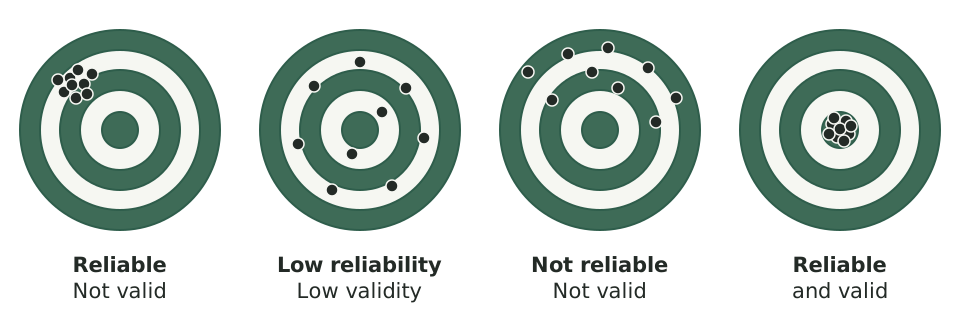
Reliability and Validity is core concern.
Reliability and Validity
What are reliability and validity?
Reliability and Validity
Reliability:
How consistent the annotation results are (e.g., across human or AI coders).
How trustworthy your reported results are.
Depends on coder, scheme, type of data, familiarity, etc.
Validity:
How well the actual annotation captures what you are proposed to capture.
Depends on the quality of your coding scheme.
Proposed steps
Eguchi & Kyle (2024) lay out the annotation-and-evaluation workflow. We compress it into five steps, and you run steps ③–⑤ yourself in S5–S6.
Step
What you do
Original
①
Define the annotation task
scope, unit of analysis, metrics
②
Operationalize into a scheme + guidelines
Write/Adapt guideline / Pilot annotation
③
Build the gold standard
Two (or more) blind coders, agreement, adjudication
④
Set the target = human agreement
the ceiling for any model
⑤
Evaluate the LLM against gold
P / R / F1, κ, confusion matrix
① Define the annotation task
Scope & purpose — What is the source text?
Design the task — input → output over a unit of analysis of choice.
Reuse or draft — adopt an existing scheme / tag set if one fits; else draft from the literature.
Choose the metrics now (P / R / F1, κ) — so evaluation is planned, not retrofitted.
Sample data to represent the domain (proficiency, L1) and fix the unit.
② Operationalize into a scheme + guidelines
Turn the theoretical construct into descriptive rules.
Fuoli (2018) gives three principles:
All choices accounted for.
Guidelines tested & refined until reliable.
Reliability always assessed — and reported.
If two trained coders can’t agree on it, a model can’t be trusted on it either.
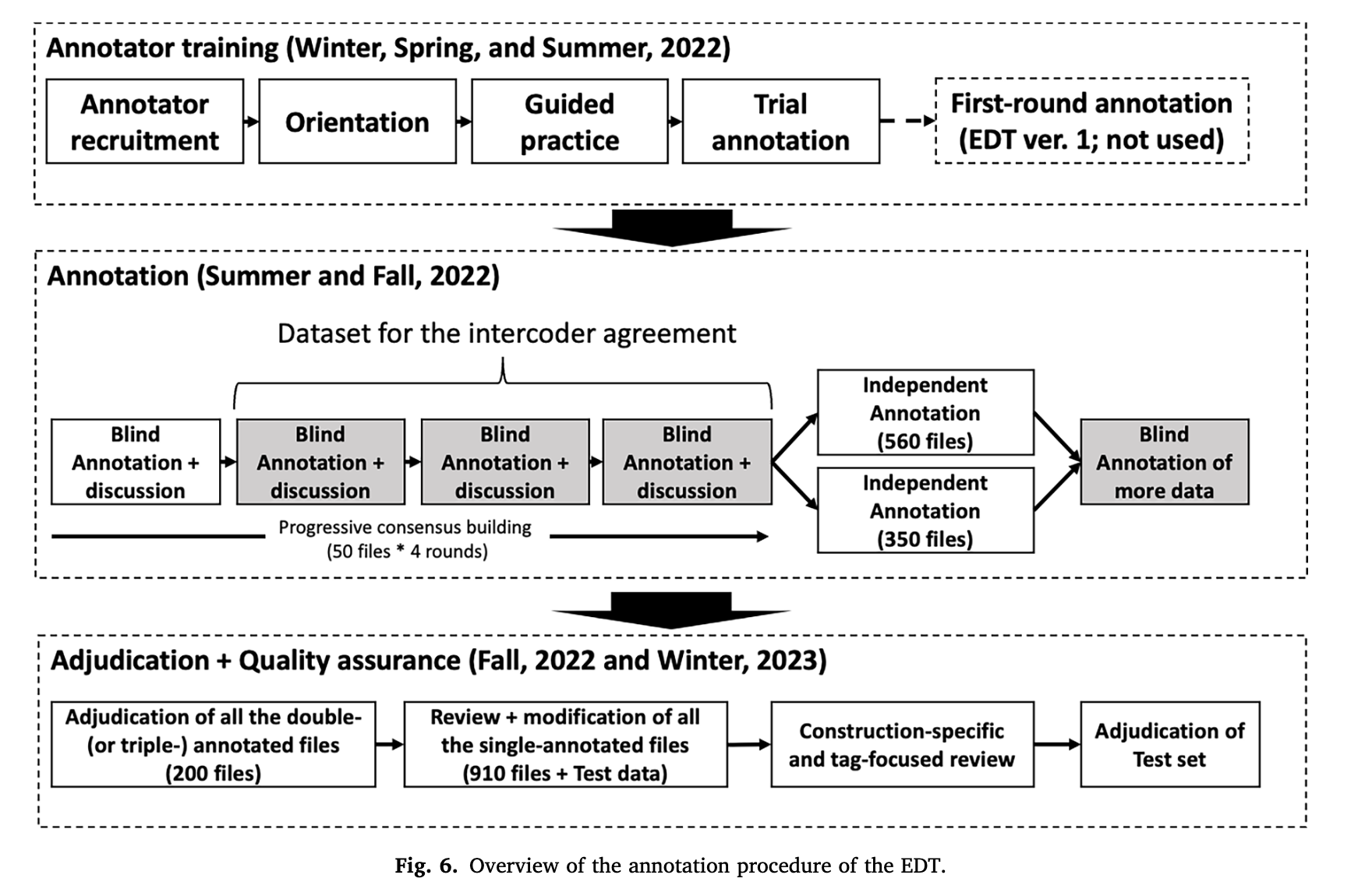
An example of an annotation process
③ Build the gold standard
Two coders annotate the same items blind.
Measure inter-annotator agreement — percent + κ.
Read the confusion matrix → refine the scheme, re-annotate.
Adjudicate disagreements → a gold standard.
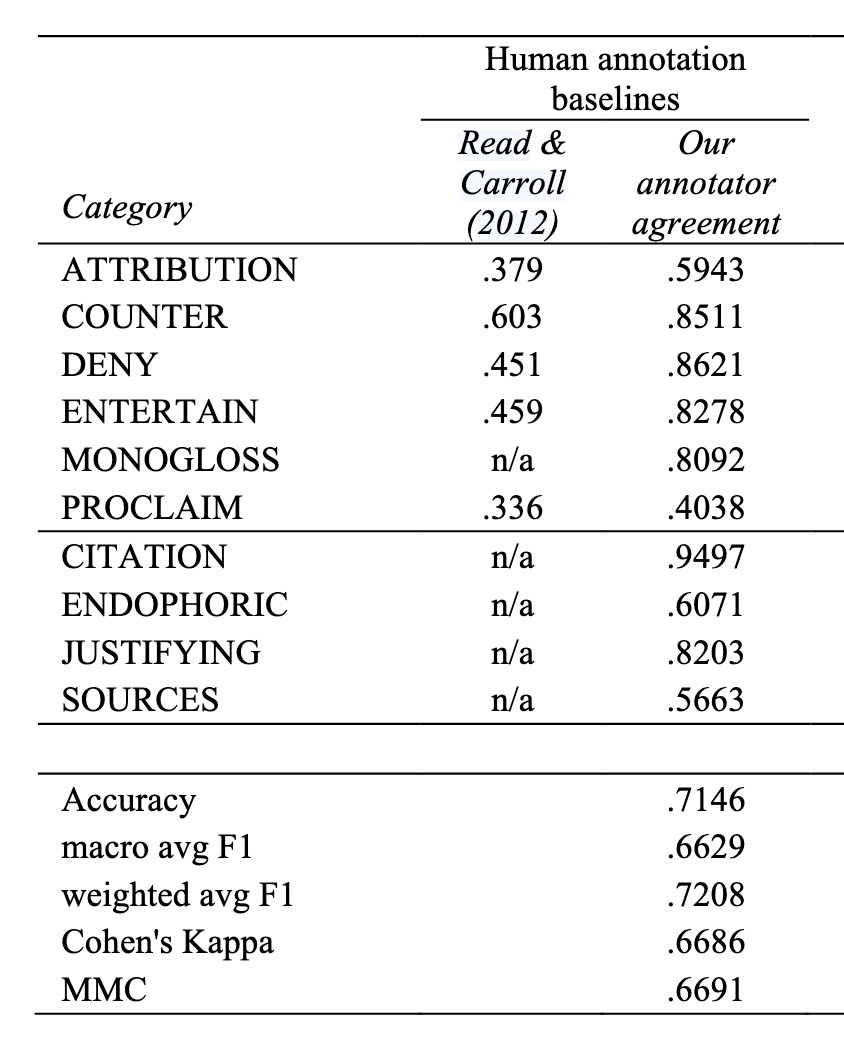
④ Measuring human agreement as a benchmark
Human inter-annotator agreement after modifying the scheme should be reported.
Human agreement lays a good benchmark.
⑤ Evaluate the LLM against gold
Finally, we will explore and evaluate LLM against gold-standard.
In classical machine-learning experiment, we split the entire dataset into three parts.
Split
Roughly
What it is for
Train
70%
The model learns from these items.
Development (validation)
15%
You compare settings here and pick the one to keep.
Test
15%
Held back until the end. Score it once → Precision · Recall · F1.
Using LLM, we might not need Train
Split
Roughly
What it is for
Development (validation)
??%
You will change the prompt as many times as you want.
Test
??%
Held back until the end. Score it once → Precision · Recall · F1.
Proposed steps
Eguchi & Kyle (2024) lay out the annotation-and-evaluation workflow. We compress it into five steps, and you run steps ③–⑤ yourself in S5–S6.
Step
What you do
Original
①
Define the annotation task
scope, unit of analysis, metrics
②
Operationalize into a scheme + guidelines
Write/Adapt guideline / Pilot annotation
③
Build the gold standard
Two (or more) blind coders, agreement, adjudication
④
Set the target = human agreement
the ceiling for any model
⑤
Evaluate the LLM against gold
P / R / F1, κ, confusion matrix
Evaluation metrics
Metrics
P / R / F1, and macro-F1 across classes.
Confusion matrix — which labels are confused with which.
Cohen’s κ — agreement corrected for chance.
Train / validation / test — the held-out logic (seed now; applied when we tune prompts in S7–S8).
The four outcomes: TP · TN · FP · FN
First pick one class as positive — say, “this sentence hedges.” Every prediction then belongs to one of four cells. Rows = gold (the truth), columns = the prediction:
Pred +
Pred −
Gold +
TP
FN
Gold −
FP
TN
TP (true positive) — labelled hedging, and it was hedging. ✅
FP (false positive) — labelled hedging, but it was not.
FN (false negative) — labelled not hedging, but it was hedging.
TN (true negative) — labelled not hedging, and it was not. ✅
Precision & Recall
Two questions about the positive class, from the same four cells. Say our detector scored the following on a batch of sentences:
Pred +
Pred −
Gold +
TP = 8
FN = 4
Gold −
FP = 2
TN = —
Precision — of everything it labelled positive, how much was correct?
Recall — of everything that was actually positive, how much did it identify?
Precision & Recall
Precision — of everything it labelled positive, how much was correct?
Not let’s say two annotators label the same 50 sentences (+/−):
Coder B
Total
+
−
Coder A
+
10
5
15(30%)
−
5
30
35(70%)
Total
15 (30%)
35 (70%)
50
Observed agreement = the diagonal ÷ total:
\[p_o = \frac{10 + 30}{50} = 0.80\]
Cohen’s κ — agreement beyond chance
Cohen’s κ (the two-rater, nominal case) subtracts the agreement you’d expect by chance:
\[\kappa = \frac{p_o - p_e}{1 - p_e}\]\(p_e\) = the agreement they would reach by chance, using each coder’s own marginal rate (row/column totals ÷ 50).
Cohen’s κ — agreement beyond chance
For each label, multiply the two coders’ rates:
\[p_e = \underbrace{P(A{+})\cdot P(B{+})}_{\text{both say }+} \;+\; \underbrace{P(A{-})\cdot P(B{-})}_{\text{both say }-}\]
Here both coders marked “+” 15/50 = 0.30 and “−” 35/50 = 0.70:
There’s no single cut-off — you read κ against a benchmark.
Cohen’s κ
Landis & Koch (1977)
McHugh (2012)
< 0.00
Poor
—
0.00–0.20
Slight
None
0.21–0.40
Fair
Minimal
0.41–0.60
Moderate
Weak
0.61–0.80
Substantial
Moderate
0.81–1.00
Almost perfect
Strong
Tip
Our two coders’ raw 80 % agreement is only κ ≈ 0.52 once chance is removed — inadequate on that rule. This difference is why κ is reported instead of raw agreement.
Dataset for class tutorials — Arase et al. (2022)
Arase, Uchida & Kajiwara (2022)
“CEFR-Based Sentence Difficulty Annotation and Assessment” (EMNLP 2022).
The problem. Simplifying text for learners requires knowing how hard a sentence is.
Goal: Creating a corpus that is annotated for sentence difficulties according to CEFR levels.
How did they operationalize CEFR levels?
Methodology
They used CEFR “can-do” statements to infer the level of the passage.
Level
Overall reading comprehension descriptor
C2
Can understand virtually all types of texts including abstract, structurally complex, or highly colloquial literary and non-literary writings.
C1
Can understand in detail lengthy, complex texts, whether or not these relate to their own area of speciality, provided they can reread difficult sections.
B2
Can read with a large degree of independence, adapting style and speed of reading to different texts and purposes. Has a broad active reading vocabulary, but may experience some difficulty with low-frequency idioms.
B1
Can read straightforward factual texts on subjects related to their field of interest with a satisfactory level of comprehension.
A2
Can understand short, simple texts on familiar matters of a concrete type which consist of high frequency everyday or job-related language.
A1
Can understand very short, simple texts a single phrase at a time, picking up familiar names, words and basic phrases and rereading as required.
Council of Europe (2020). Common European Framework of Reference for Languages: Learning, teaching, assessment — Companion volume.
A problem with the approach
The descriptors describe what a learner can do — not what a sentence is.
They talk about text types (“literary writings”, “factual texts”) and reading conditions (“provided they can reread”).
None of that applies to a single, context-free sentence.
Making the scale apply to one sentence is the design problem
What the labels look like
One example sentence per level, from the corpus (Arase et al., 2022, Table 1):
Input — one sentence
→
Output — one level
She had a beautiful necklace around her neck.
→
A1
Some experts say the classes should be changed.
→
A2
Historically there have also been negative consequences.
→
B1
Alligators are generally timid towards humans and tend to walk or swim away if one approaches.
→
B2
The metal-carbon bond in organometallic compounds is generally highly covalent.
→
C1
In the past, non-photosynthetic plants were mistakenly thought to get food by breaking down organic matter in a manner similar to saprotrophic fungi.
→
C2
Why do we use CEFR-SP project?
The task is familiar. Simplification — and judging what level a sentence is pitched at — is something language teachers and applied linguists are interested in.
The task is simple enough. One sentence, one label. Simple enough for the tutorial example.
→ A good tutorial project. Interesting enough to be worth doing, small enough to actually finish in five days.
Note
Skim §3.1 and §3.2 — about a page and a half. That’s where we start the afternoon session.
In the afternoon
S5 — Gold-Standard Annotation & Agreement(hands-on): extract Arase’s two design decisions, then build a gold standard and measure agreement — executes Phases ①–③.
S6 — Gold Standards & Evaluation Metrics(hands-on): score an LLM against that gold — executes Phases ④–⑤.