Linguistic Data Analysis II · Day 4
Session 10: Using LLM in your research
Day 4 · Methodology & Pipeline Assembly (4-1)
Masaki EGUCHI, Ph.D.
Tohoku University · Summer 2026
📋 Agenda
- Abdurahman et al. (2025) — principles for evaluating LLM research
- Mizumoto et al. (2024) — reviewing the paper using principles
- Your mini-project — make and report defensible decisions
🎯 Learning Objectives
By the end of this session, you will be able to:
- Distinguish reproducibility, robustness, and validity.
- Critically evaluate the methodology of an LLM-based annotation study.
- Apply the evaluation principles to your mini-project.
Four principles for using LLMs in research
- Document the process
- model, version, access date, parameters, prompt, code, and data
- Validate against appropriate evidence
- compare LLM outputs with independently produced human judgments
- Test robustness
- examine reasonable changes in prompts, examples, settings, and samples
- Limit the claim
- state exactly what the evidence supports—and what it does not
Research Practices
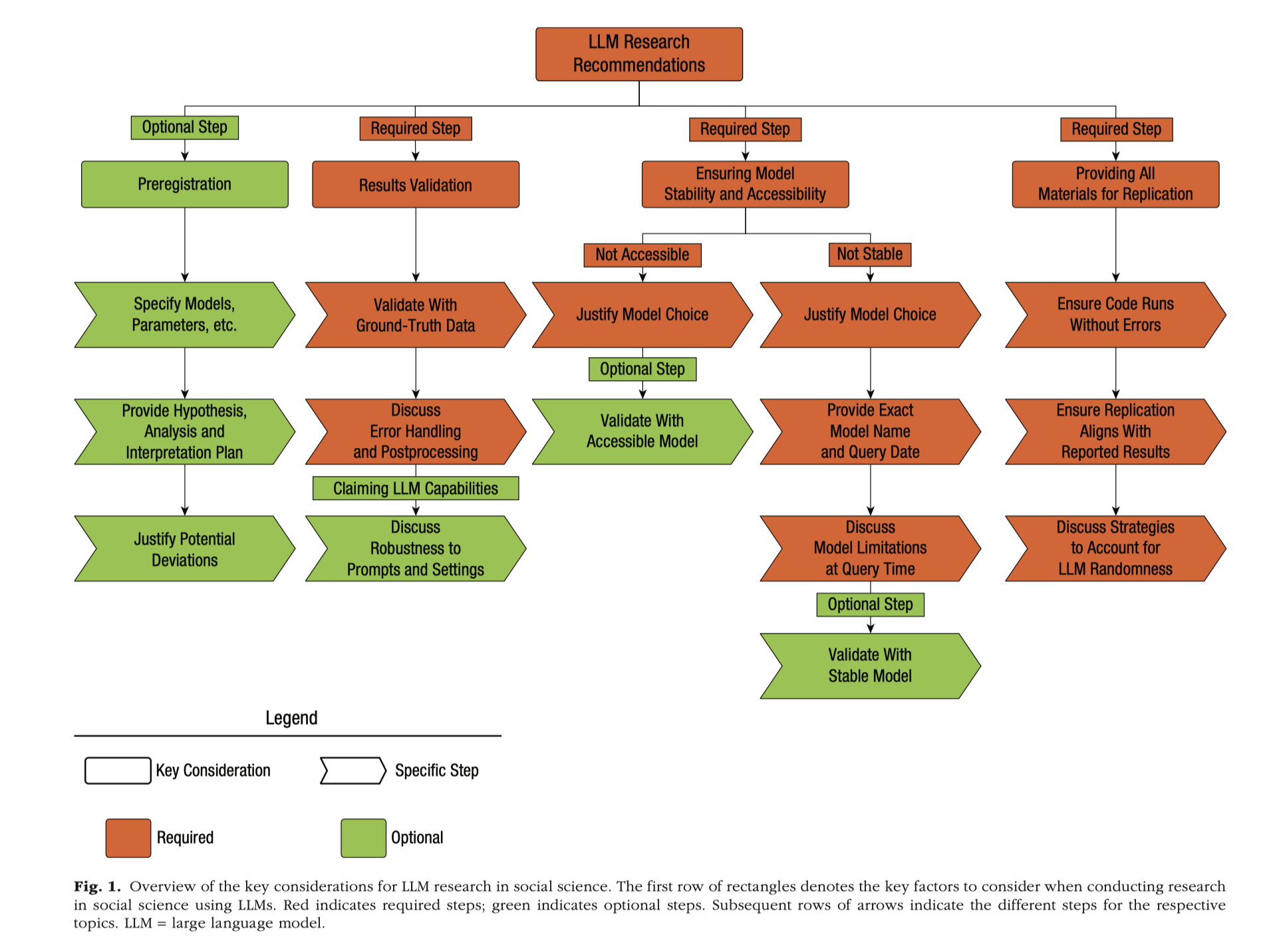
Your questions
- Which model to use? How can we use a appropriate model?
- Use basic models
- Follow literature
- Try different models and report highest
- Report all (robust)
- Stability:
- Stabilities
- Model availability & Temperature
- how do we know that our gold is gold?
Reproducibility
What is reproducibility?
Record and preserve:
- exact model and version
- date of access
- complete prompt and examples
- model parameters
- sampling procedure and seed
- code and data-processing decisions
- original, unedited model outputs
How can LLM threaten preproducibility?
- Any ideas?
- Non-determinism
- Model change / Model retire.
Why temperature=0 is not enough
temperature=0 says “always take the most likely next token.” That should be deterministic.
It mostly is. But you are calling a hosted service:
- the model behind the name can be updated underneath
- batching and hardware differences perturb floating-point arithmetic
- the endpoint may silently fall back to another region
There are choices to use open-source local LLM, but we need to have a good computer to run.
Robustness
What is robustness in research findings in your workds?
How does methodological choice influence the results?
Robustness
Possible changes include:
- prompt wording
- few-shot examples and their order
- model parameters
- repeated runs
- model or model version
- validation sample
A high score from one selected configuration does not show that the result is robust.
What would you vary?
Discuss which might affect the result most?
- Prompt wording
- Few-shot examples
- Model run
- Validation sample
What result would increase your confidence about robustness?
Validity
Does the evidence support the interpretation we want to make?
Ask:
- Is the construct clearly defined?
- Does the gold standard represent that construct?
- Are the human judgments sufficiently trustworthy?
- Does the metric answer the research question?
- Are errors systematic for particular categories or texts?
- How far can the result be generalized?
Any questions?
Ethics
Ethical consideration
Privacy. Learner data is people’s writing. ICNALE is licensed for research use only and may not be redistributed — which is why it is excluded from git and from your submission bundle by name.
Authorship. The model is a tool, not a co-author. But what it did belongs in your methods: which model, which prompt, which parameters.
Licences have practical consequences. CEFR-SP is CC BY-SA: anything you redistribute from it inherits share-alike. That is why the template’s data folder carries its own LICENSE file.
Responsible use of learner data
Before sharing your project:
- protect private learner writing
- follow the dataset licence
- report how the LLM was used
- do not redistribute restricted data
Question?
Mizumoto (2025)
Mizumoto (2025) : What does the tool do?
Introduces Auto Error Analyzer.
Input: L2 learner writing
Output:
- Number and type of errors
- Errors per 100 words
- Errors per T-unit or clause
- etc.
The data and codes are available at Open Science Framework.
In-class reading — 20 minutes
Focus on:
- pp. 6–11: tool, prompt, and error-analysis pipeline
- pp. 11–13: validation design and results
- pp. 14–15: limitations and conclusions
You do not need to read every sentence.
Prepare to explain your assigned section to the class.
Read as a methodological reviewer
Pipeline · pp. 6–11
How does the tool turn corrections into error instances and categories?
Human reference · pp. 11–12
How were human judgments created, compared, and adjudicated?
Evaluation · pp. 12–13
What do r = .94 and micro-F1 = .95 each demonstrate?
Limitations · pp. 14–15
How does the author limit the interpretation and generalizability?
Audit 1: Validity
- What counts as an “error”?
- Who created the human reference annotations?
- How were disagreements resolved?
- Does aggregate F1 establish accuracy for all 23 categories?
Audit 2: Robustness
Would the conclusion remain similar with:
- another reasonable prompt?
- a different order or choice of examples?
- another model or model version?
- repeated LLM runs?
- another sample of essays?
- writers with other L1s or proficiency levels?
Audit 3: Reproducibility
Can we identify and recover:
- the exact model and hosted endpoint?
- the access date?
- all prompts?
- model parameters?
- the validation sample?
- the sampling seed?
- the output-processing rules?
- the analysis code?
- frozen model outputs?
Our evaluation of Mizumoto (2025)
| Dimension | Strength | Remaining uncertainty |
|---|---|---|
| Reproducibility | ||
| Robustness | ||
| Validity | ||
| Generalizability |
We will complete this table together.
Apply the audit to your project
Make five decisions
Discuss and record:
- What exactly counts as an error match?
- How will you construct and adjudicate the human reference?
- Which metrics will you report, and why?
- What will you save so the analysis can be reconstructed?
- What is the strongest limitation on your final claim?
Six sections I expect in your report
| Section | The thing that makes it good | |
|---|---|---|
| 1 | Intro | why this topic matters |
| 2 | Methodology | sampling · scheme & gold · split — and what adjudication changed |
| 3 | Prompt iterations | a reason per round, not just an F1 |
| 4 | Evaluation | which class did worst, and what it got confused with |
| 5 | Error analysis | model error or unclear scheme — with evidence |
| 6 | Limitations | ≥2 that apply to your run |
Two pages, written individually. One study per group, one report per person.
Any questions?
Next: S11 — we assemble the pipeline and you write your
Linguistic Data Analysis II